HybridMedianComparison
Repository source: HybridMedianComparison
Description
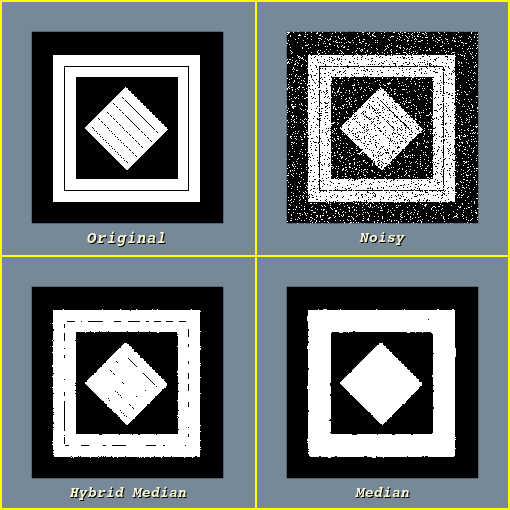
Comparison of median and hybrid-median filters. The hybrid filter preserves corners and thin lines, better than the median filter. The lower patterns represent the three neighborhoods used to compute the hybrid median.
Info
See this figure in Chapter 10 the VTK Textbook.
Question
If you have a question about this example, please use the VTK Discourse Forum
Code
HybridMedianComparison.py
#!/usr/bin/env python3

from collections import namedtuple
from dataclasses import dataclass

# noinspection PyUnresolvedReferences
import vtkmodules.vtkRenderingOpenGL2
from vtkmodules.util.execution_model import select_ports
from vtkmodules.vtkCommonColor import vtkNamedColors
from vtkmodules.vtkCommonCore import vtkPoints
from vtkmodules.vtkCommonDataModel import vtkCellArray, vtkPolyData, vtkPolyLine
from vtkmodules.vtkCommonDataModel import vtkImageData
from vtkmodules.vtkIOImage import vtkImageReader2Factory
from vtkmodules.vtkImagingCore import (
    vtkImageBinaryThreshold,
    vtkImageCast,
)
from vtkmodules.vtkImagingGeneral import (
    vtkImageHybridMedian2D,
    vtkImageMedian3D
)
from vtkmodules.vtkImagingMath import vtkImageMathematics
from vtkmodules.vtkImagingSources import vtkImageNoiseSource
from vtkmodules.vtkInteractionStyle import vtkInteractorStyleImage
from vtkmodules.vtkInteractionWidgets import (
    vtkTextRepresentation,
    vtkTextWidget
)
from vtkmodules.vtkRenderingCore import (
    vtkActor2D,
    vtkCoordinate,
    vtkImageActor,
    vtkImageProperty,
    vtkPolyDataMapper2D,
    vtkRenderWindow,
    vtkRenderWindowInteractor,
    vtkRenderer,
    vtkTextActor,
    vtkTextProperty
)


def get_program_parameters():
    import argparse
    description = 'Comparison of median and hybrid-median filters.'
    epilogue = '''
    The hybrid filter preserves corners and thin lines, better than the median filter.
    '''
    parser = argparse.ArgumentParser(description=description, epilog=epilogue,
                                     formatter_class=argparse.RawDescriptionHelpFormatter)
    parser.add_argument('filename', help='TestPattern.png.')
    args = parser.parse_args()
    return args.filename


def main():
    colors = vtkNamedColors()

    file_name = get_program_parameters()

    # Read the image.
    reader = vtkImageReader2Factory().CreateImageReader2(file_name)
    reader.file_name = file_name
    reader.update()

    scalar_range = reader.output.point_data.scalars.range
    extent = reader.output.extent
    middle_slice = (extent[5] - extent[4]) // 2
    print(f'Range: {scalar_range}, middle slice: {middle_slice}')

    # Work with double images.
    cast = vtkImageCast(output_scalar_type=ImageCast.OutputScalarType.VTK_DOUBLE)

    original_data = vtkImageData()
    original_data.DeepCopy((reader >> cast).update().output)

    noisy_data = add_shot_noise(original_data, 2000.0, 0.1, reader.GetOutput().GetExtent())

    median = vtkImageMedian3D(input_data=noisy_data, kernel_size=(5, 5, 1))

    hybrid_median1 = vtkImageHybridMedian2D(input_data=noisy_data)
    hybrid_median = vtkImageHybridMedian2D()
    hybrid_median1 >> hybrid_median

    color_window = (scalar_range[1] - scalar_range[0]) * 0.8
    color_level = color_window / 2

    image_property = vtkImageProperty(color_window=color_window, color_level=color_level,
                                      interpolation_type=ImageProperty.InterpolationType.VTK_NEAREST_INTERPOLATION)

    display_extent = reader.data_extent[:4] + (middle_slice, middle_slice)

    # Link the actors to the pipelines.
    actors = dict()

    actors['Original'] = vtkImageActor(property=image_property, display_extent=display_extent)
    actors['Original'].mapper.input_data = original_data

    actors['Noisy'] = vtkImageActor(property=image_property, display_extent=actors['Original'].display_extent)
    actors['Noisy'].mapper.input_data = noisy_data

    actors['Hybrid Median'] = vtkImageActor(property=image_property, display_extent=actors['Original'].display_extent)
    hybrid_median >> actors['Hybrid Median'].mapper

    actors['Median'] = vtkImageActor(property=image_property, display_extent=actors['Original'].display_extent)
    median >> actors['Median'].mapper

    keys = list(actors.keys())

    # Define the size of the grid that will hold the objects.
    grid_cols = 2
    grid_rows = 2
    # Define side length (in pixels) of each renderer rectangle.
    col_size = 400
    row_size = 400
    size = (col_size * grid_cols, row_size * grid_rows)
    ren_win = vtkRenderWindow(size=size, window_name='HybridMedianComparison')

    iren = vtkRenderWindowInteractor()
    iren.render_window = ren_win
    style = vtkInteractorStyleImage()
    iren.interactor_style = style

    viewports = dict()
    VP_Params = namedtuple('VP_Params', ['viewport', 'border'])
    last_col = False
    last_row = False
    for row in range(0, grid_rows):
        if row == grid_rows - 1:
            last_row = True
        for col in range(0, grid_cols):
            if col == grid_cols - 1:
                last_col = True
            index = row * grid_cols + col
            # (x_min, y_min, x_max, y_max)
            viewport = (
                float(col) / grid_cols,
                float(grid_rows - row - 1) / grid_rows,
                float(col + 1) / grid_cols,
                float(grid_rows - row) / grid_rows
            )

            if last_row and last_col:
                border = ViewPortBorders.tlbr
                last_row = False
                last_col = False
            elif last_col:
                border = ViewPortBorders.rtl
                last_col = False
            elif last_row:
                border = ViewPortBorders.tlb
            else:
                border = ViewPortBorders.tl
            vp_params = VP_Params(viewport, border)
            viewports[keys[index]] = vp_params

    # Add the actors to the renderers.
    renderers = dict()
    for k in actors.keys():
        renderers[k] = vtkRenderer(background=colors.GetColor3d("LightSlateGray"), viewport=viewports[k].viewport)
        renderers[k].AddActor(actors[k])
        ren_win.AddRenderer(renderers[k])

    # Create one text property for all.
    text_property = vtkTextProperty(color=colors.GetColor3d('LightGoldenrodYellow'), bold=True, italic=True,
                                    shadow=True, font_family_as_string='Courier',
                                    font_size=16, justification=TextProperty.Justification.VTK_TEXT_CENTERED)
    text_positions = get_text_positions(keys, justification=TextProperty.Justification.VTK_TEXT_CENTERED, width=0.5)

    # Create the text widgets.
    text_representations = list()
    text_actors = list()
    text_widgets = list()
    index = 0
    for k in actors.keys():
        # Create the text actor and representation.
        text_actors.append(
            vtkTextActor(input=k,
                         text_scale_mode=vtkTextActor.TEXT_SCALE_MODE_NONE,
                         text_property=text_property))

        # Create the text representation. Used for positioning the text actor.
        text_representations.append(vtkTextRepresentation(enforce_normalized_viewport_bounds=True))
        text_representations[index].position_coordinate.value = text_positions[k]['p']
        text_representations[index].position2_coordinate.value = text_positions[k]['p2']

        # Create the text widget, setting the default renderer and interactor.
        text_widgets.append(
            vtkTextWidget(representation=text_representations[index], text_actor=text_actors[index],
                          default_renderer=renderers[k], interactor=iren, selectable=False))
        index += 1

    # Draw a line around the viewport of each renderer.
    for k in actors.keys():
        border = viewports[k].border
        # draw_viewport_border(renderers[k], border=border, color=colors.GetColor3d('Yellow'), line_width=4)
        draw_viewport_border(renderers[k], sides=border, border_color='Yellow', border_width=4)

    # The renderers share one camera.
    ren_win.Render()
    renderers['Original'].active_camera.Dolly(1.1)
    renderers['Original'].ResetCameraClippingRange()
    camera = renderers['Original'].active_camera
    for k in actors.keys():
        if k != 'Original':
            renderers[k].SetActiveCamera(camera)
    ren_win.Render()

    for i in range(0, len(text_widgets)):
        text_widgets[i].On()

    iren.Initialize()
    iren.Start()


def add_shot_noise(input_image, noise_amplitude, noise_fraction, extent):
    shot_noise_source = vtkImageNoiseSource(whole_extent=extent, minimum=0.0, maximum=1.0)

    shot_noise_thresh1 = vtkImageBinaryThreshold(in_value=0, out_value=noise_amplitude,
                                                 threshold_function=vtkImageBinaryThreshold.THRESHOLD_UPPER,
                                                 lower_threshold=1.0 - noise_fraction,
                                                 replace_in=True, replace_out=True)
    shot_noise_source >> shot_noise_thresh1

    shot_noise_thresh2 = vtkImageBinaryThreshold(in_value=1.0 - noise_amplitude, out_value=noise_amplitude,
                                                 threshold_function=vtkImageBinaryThreshold.THRESHOLD_UPPER,
                                                 lower_threshold=noise_fraction,
                                                 replace_in=True, replace_out=True)
    shot_noise_source >> shot_noise_thresh2

    shot_noise = vtkImageMathematics(operation=ImageMathematics.Operation.VTK_ADD)
    shot_noise_thresh1 >> select_ports(shot_noise, 0)
    shot_noise_thresh2 >> select_ports(shot_noise, 1)

    add = vtkImageMathematics(operation=ImageMathematics.Operation.VTK_ADD)
    input_image >> select_ports(add, 0)
    shot_noise >> select_ports(add, 1)

    add.update()

    output_image = vtkImageData()
    output_image.DeepCopy(add.GetOutput())
    return output_image


def get_text_positions(names, justification=0, vertical_justification=0, width=0.96, height=0.1):
    """
    Get viewport positioning information for a list of names.

    :param names: The list of names.
    :param justification: Horizontal justification of the text, default is left.
    :param vertical_justification: Vertical justification of the text, default is bottom.
    :param width: Width of the bounding_box of the text in screen coordinates.
    :param height: Height of the bounding_box of the text in screen coordinates.
    :return: A list of positioning information.
    """
    # The gap between the left or right edge of the screen and the text.
    dx = 0.02
    width = abs(width)
    if width > 0.96:
        width = 0.96

    y0 = 0.01
    height = abs(height)
    if height > 0.9:
        height = 0.9
    dy = height
    if vertical_justification == TextProperty.VerticalJustification.VTK_TEXT_TOP:
        y0 = 1.0 - (dy + y0)
        dy = height
    if vertical_justification == TextProperty.VerticalJustification.VTK_TEXT_CENTERED:
        y0 = 0.5 - (dy / 2.0 + y0)
        dy = height

    name_len_min = 0
    name_len_max = 0
    first = True
    for k in names:
        sz = len(k)
        if first:
            name_len_min = name_len_max = sz
            first = False
        else:
            name_len_min = min(name_len_min, sz)
            name_len_max = max(name_len_max, sz)
    text_positions = dict()
    for k in names:
        sz = len(k)
        delta_sz = width * sz / name_len_max
        if delta_sz > width:
            delta_sz = width

        if justification == TextProperty.Justification.VTK_TEXT_CENTERED:
            x0 = 0.5 - delta_sz / 2.0
        elif justification == TextProperty.Justification.VTK_TEXT_RIGHT:
            x0 = 1.0 - dx - delta_sz
        else:
            # Default is left justification.
            x0 = dx

        # For debugging!
        # print(
        #     f'{k:16s}: (x0, y0) = ({x0:3.2f}, {y0:3.2f}), (x1, y1) = ({x0 + delta_sz:3.2f}, {y0 + dy:3.2f})'
        #     f', width={delta_sz:3.2f}, height={dy:3.2f}')
        text_positions[k] = {'p': [x0, y0, 0], 'p2': [delta_sz, dy, 0]}

    return text_positions


def draw_viewport_border(renderer, sides, border_color, border_width):
    """
    Set a border around a viewport.

    :param renderer: The renderer corresponding to the viewport.
    :param sides: An array of boolean corresponding to [top, left, bottom, right]
    :param border_color: The color of the border.
    :param border_width: The width of the border.
    :return:
    """
    colors = vtkNamedColors()

    # Points start at upper right and proceed anti-clockwise.
    points = vtkPoints()
    points.SetNumberOfPoints(4)
    points.InsertPoint(0, 1, 1, 0)
    points.InsertPoint(1, 0, 1, 0)
    points.InsertPoint(2, 0, 0, 0)
    points.InsertPoint(3, 1, 0, 0)

    cells = vtkCellArray()
    cells.Initialize()

    if sides[0]:
        # Top
        top = vtkPolyLine()
        top.GetPointIds().SetNumberOfIds(2)
        top.GetPointIds().SetId(0, 0)
        top.GetPointIds().SetId(1, 1)
        cells.InsertNextCell(top)
    if sides[1]:
        # Left
        left = vtkPolyLine()
        left.GetPointIds().SetNumberOfIds(2)
        left.GetPointIds().SetId(0, 1)
        left.GetPointIds().SetId(1, 2)
        cells.InsertNextCell(left)
    if sides[2]:
        # Bottom
        bottom = vtkPolyLine()
        bottom.GetPointIds().SetNumberOfIds(2)
        bottom.GetPointIds().SetId(0, 2)
        bottom.GetPointIds().SetId(1, 3)
        cells.InsertNextCell(bottom)
    if sides[3]:
        # Right
        right = vtkPolyLine()
        right.GetPointIds().SetNumberOfIds(2)
        right.GetPointIds().SetId(0, 3)
        right.GetPointIds().SetId(1, 0)
        cells.InsertNextCell(right)

    # Now make the polydata and display it.
    poly = vtkPolyData()
    poly.Initialize()
    poly.SetPoints(points)
    poly.SetLines(cells)

    # Use normalized viewport coordinates since
    # they are independent of window size.
    coordinate = vtkCoordinate()
    coordinate.SetCoordinateSystemToNormalizedViewport()

    mapper = vtkPolyDataMapper2D()
    mapper.SetInputData(poly)
    mapper.SetTransformCoordinate(coordinate)

    actor = vtkActor2D()
    actor.SetMapper(mapper)
    actor.GetProperty().SetColor(colors.GetColor3d(border_color))

    # Line width should be at least 2 to be visible at extremes.
    actor.GetProperty().SetLineWidth(border_width)

    renderer.AddViewProp(actor)


@dataclass(frozen=True)
class ViewPortBorders:
    # Define borders for the viewports  = [top, left, bottom, right].
    t = [True, False, False, False]
    l = [False, True, False, False]
    b = [False, False, True, False]
    r = [False, False, False, True]
    lb = [False, True, True, False]
    lbr = [False, True, True, True]
    tlb = [True, True, True, False]
    tlbr = [True, True, True, True]
    rtl = [True, True, False, True]
    tl = [True, True, False, False]


@dataclass(frozen=True)
class Coordinate:
    @dataclass(frozen=True)
    class CoordinateSystem:
        VTK_DISPLAY: int = 0
        VTK_NORMALIZED_DISPLAY: int = 1
        VTK_VIEWPORT: int = 2
        VTK_NORMALIZED_VIEWPORT: int = 3
        VTK_VIEW: int = 4
        VTK_POSE: int = 5
        VTK_WORLD: int = 6
        VTK_USERDEFINED: int = 7


@dataclass(frozen=True)
class ImageCast:
    @dataclass(frozen=True)
    class OutputScalarType:
        VTK_CHAR: int = 2
        VTK_UNSIGNED_CHAR: int = 3
        VTK_SHORT: int = 4
        VTK_UNSIGNED_SHORT: int = 5
        VTK_INT: int = 6
        VTK_UNSIGNED_INT: int = 7
        VTK_LONG: int = 8
        VTK_UNSIGNED_LONG: int = 9
        VTK_FLOAT: int = 10
        VTK_DOUBLE: int = 11


@dataclass(frozen=True)
class ImageMathematics:
    @dataclass(frozen=True)
    class Operation:
        VTK_ADD: int = 0
        VTK_SUBTRACT: int = 1
        VTK_MULTIPLY: int = 2
        VTK_DIVIDE: int = 3
        VTK_INVERT: int = 4
        VTK_SIN: int = 5
        VTK_COS: int = 6
        VTK_EXP: int = 7
        VTK_LOG: int = 8
        VTK_ABS: int = 9
        VTK_SQR: int = 10
        VTK_SQRT: int = 11
        VTK_MIN: int = 12
        VTK_MAX: int = 13
        VTK_ATAN: int = 14
        VTK_ATAN2: int = 15
        VTK_MULTIPLYBYK: int = 16
        VTK_ADDC: int = 17
        VTK_CONJUGATE: int = 18
        VTK_COMPLEX_MULTIPLY: int = 19
        VTK_REPLACECBYK: int = 20


@dataclass(frozen=True)
class ImageProperty:
    @dataclass(frozen=True)
    class InterpolationType:
        VTK_NEAREST_INTERPOLATION: int = 0
        VTK_LINEAR_INTERPOLATION: int = 1
        VTK_CUBIC_INTERPOLATION: int = 2


@dataclass(frozen=True)
class TextProperty:
    @dataclass(frozen=True)
    class Justification:
        VTK_TEXT_LEFT: int = 0
        VTK_TEXT_CENTERED: int = 1
        VTK_TEXT_RIGHT: int = 2

    @dataclass(frozen=True)
    class VerticalJustification:
        VTK_TEXT_BOTTOM: int = 0
        VTK_TEXT_CENTERED: int = 1
        VTK_TEXT_TOP: int = 2


if __name__ == '__main__':
    main()