MedicalDemo1
Repository source: MedicalDemo1
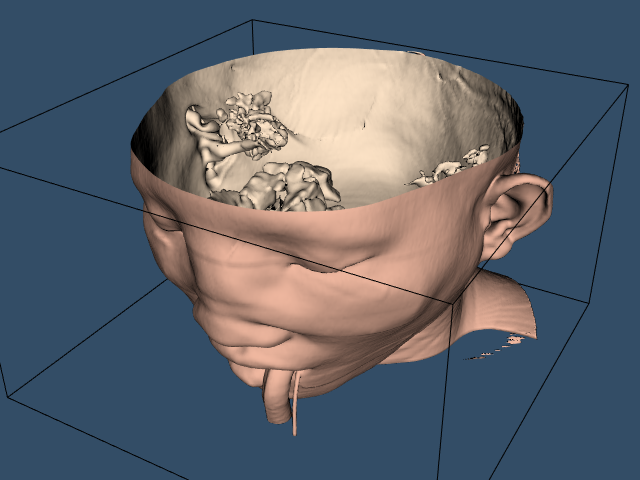
Description
The skin extracted from a CT dataset of the head.
usage
MedicalDemo1 FullHead.mhd
Note
The skin color was selected from Table 7 in Improvement of Haar Feature Based Face Detection in OpenCV Incorporating Human Skin Color Characteristic
Note
The original source code for this example is here.
Info
See Figure 12-2 in Chapter 12 the VTK Textbook.
Info
The example uses src/Testing/Data/FullHead.mhd which references src/Testing/Data/FullHead.raw.gz.
Question
If you have a question about this example, please use the VTK Discourse Forum
Code
MedicalDemo1.py
#!/usr/bin/env python3

import sys
from pathlib import Path

# noinspection PyUnresolvedReferences
import vtkmodules.vtkInteractionStyle
# noinspection PyUnresolvedReferences
import vtkmodules.vtkRenderingOpenGL2
from vtkmodules.vtkCommonColor import vtkNamedColors
from vtkmodules.vtkCommonMath import vtkMatrix4x4
from vtkmodules.vtkCommonTransforms import vtkTransform
from vtkmodules.vtkFiltersCore import (
    vtkFlyingEdges3D,
    vtkMarchingCubes
)
from vtkmodules.vtkFiltersModeling import vtkOutlineFilter
from vtkmodules.vtkIOImage import vtkMetaImageReader
from vtkmodules.vtkInteractionWidgets import (
    vtkCameraOrientationWidget,
    vtkCameraOrientationRepresentation
)
from vtkmodules.vtkRenderingCore import (
    vtkActor,
    vtkCamera,
    vtkPolyDataMapper,
    vtkProperty,
    vtkRenderWindow,
    vtkRenderWindowInteractor,
    vtkRenderer
)


def main():
    colors = vtkNamedColors()

    file_name, use_flying_edges = get_program_parameters()

    colors.SetColor('SkinColor', 240, 184, 160, 255)
    colors.SetColor('BackfaceColor', 255, 229, 200, 255)
    colors.SetColor('BkgColor', 51, 77, 102, 255)

    # Create the renderer, the render window, and the interactor. The renderer
    # draws into the render window, the interactor enables mouse- and
    # keyboard-based interaction with the data within the render window.
    #
    # Set a background color for the renderer and set the name and
    # size of the render window (expressed in pixels).
    ren = vtkRenderer(background=colors.GetColor3d('BkgColor'))
    ren_win = vtkRenderWindow(size=(640, 480),
                              window_name=f'{Path(sys.argv[0]).stem:s}')
    ren_win.AddRenderer(ren)

    iren = vtkRenderWindowInteractor()
    iren.render_window = ren_win
    # Since we import vtkmodules.vtkInteractionStyle we can do this
    # because vtkInteractorStyleSwitch is automatically imported:
    iren.interactor_style.SetCurrentStyleToTrackballCamera()

    reader = vtkMetaImageReader(file_name=file_name)

    # An isosurface, or contour value of 500 is known to correspond to the
    # skin of the patient.
    if use_flying_edges:
        skin_extractor = vtkFlyingEdges3D()
    else:
        skin_extractor = vtkMarchingCubes()
    skin_extractor.SetValue(0, 500)

    skin_mapper = vtkPolyDataMapper(scalar_visibility=False)
    reader >> skin_extractor >> skin_mapper

    skin_prop = vtkProperty(diffuse_color=colors.GetColor3d('SkinColor'))
    back_prop = vtkProperty(diffuse_color=colors.GetColor3d('BackfaceColor'))
    skin = vtkActor(mapper=skin_mapper, property=skin_prop, backface_property=back_prop)

    # An outline provides context around the data.
    #
    outline_data = vtkOutlineFilter()

    outline_mapper = vtkPolyDataMapper()
    reader >> outline_data >> outline_mapper

    outline_prop = vtkProperty(diffuse_color=colors.GetColor3d('Black'))
    outline = vtkActor(mapper=outline_mapper, property=outline_prop)

    # This transform positions the actors correctly.
    # The face of the head will now face the observer.
    permute = Permute()
    lsa = permute.get_transform('si')

    outline.SetUserTransform(lsa)
    skin.SetUserTransform(lsa)

    # It is convenient to create an initial view of the data. The FocalPoint
    # and Position form a vector direction. Later on (ResetCamera() method)
    # this vector is used to position the camera to look at the data in
    # this direction.
    # camera = vtkCamera(view_up=(0, 0, 1), position=(0, -1, 0), focal_point=(0, 0, 0))
    # camera.ComputeViewPlaneNormal()
    camera = vtkCamera()
    camera.Azimuth(30.0)
    camera.Elevation(30.0)

    # Actors are added to the renderer. An initial camera view is created.
    # The Dolly() method moves the camera towards the FocalPoint,
    # thereby enlarging the image.
    ren.AddActor(outline)
    ren.AddActor(skin)
    ren.active_camera = camera
    ren.ResetCamera()
    camera.Dolly(1.5)

    # Note that when camera movement occurs (as it does in the Dolly()
    # method), the clipping planes often need adjusting. Clipping planes
    # consist of two planes: near and far along the view direction. The
    # near plane clips out objects in front of the plane the far plane
    # clips out objects behind the plane. This way only what is drawn
    # between the planes is actually rendered.
    ren.ResetCameraClippingRange()

    category = 'LSA'
    cp = COWPlacement()
    cow = cp.make_cow(ren, category)
    # Enable the widget.
    cow.On()

    # Initialize the event loop and then start it.
    iren.Initialize()
    iren.Start()


def get_program_parameters():
    import argparse
    description = 'The skin extracted from a CT dataset of the head.'
    epilogue = '''
    Derived from VTK/Examples/Cxx/Medical1.cxx
    This example reads a volume dataset, extracts an isosurface that
     represents the skin and displays it.
    '''
    parser = argparse.ArgumentParser(description=description, epilog=epilogue,
                                     formatter_class=argparse.RawDescriptionHelpFormatter)
    parser.add_argument('filename', help='FullHead.mhd.')
    parser.add_argument('-m', '--marching_cubes', action='store_false',
                        help='Use Marching Cubes instead of Flying Edges.')
    args = parser.parse_args()
    return args.filename, args.marching_cubes


class Permute:
    """
    These transformations permute image and other geometric data to maintain proper
     orientation regardless of the acquisition order. After applying these transforms with
    vtkTransformFilter, a view up of 0, -1, 0 will result in the body part
    facing the viewer.
    NOTE: some transformations have a -1 scale factor for one of the components.
          To ensure proper polygon orientation and normal direction, you must
          apply the vtkPolyDataNormals filter.

    Naming (the nomenclature is medical):
    si - superior to inferior (top to bottom)
    is - inferior to superior (bottom to top)
    ap - anterior to posterior (front to back)
    pa - posterior to anterior (back to front)
    lr - left to right
    rl - right to left
    """

    def __init__(self):
        self.si_mat = vtkMatrix4x4([[1, 0, 0, 0], [0, 0, 1, 0], [0, -1, 0, 0], [0, 0, 0, 1]])
        self.is_mat = vtkMatrix4x4([[1, 0, 0, 0], [0, 0, -1, 0], [0, -1, 0, 0], [0, 0, 0, 1]])
        self.lr_mat = vtkMatrix4x4([[0, 0, -1, 0], [0, -1, 0, 0], [1, 0, 0, 0], [0, 0, 0, 1]])
        self.rl_mat = vtkMatrix4x4([[0, 0, 1, 0], [0, -1, 0, 0], [1, 0, 0, 0], [0, 0, 0, 1]])

        self.transform = dict()
        self.generate_transforms()

    def generate_transforms(self):
        """
        Generate the transforms and collect them into a dict.
        """
        si_trans = vtkTransform()
        si_trans.SetMatrix(self.si_mat)
        self.transform['si'] = si_trans

        is_trans = vtkTransform()
        is_trans.SetMatrix(self.is_mat)
        self.transform['is'] = is_trans

        ap_trans = vtkTransform()
        ap_trans.Scale(1, -1, 1)
        self.transform['ap'] = ap_trans

        pa_trans = vtkTransform()
        pa_trans.Scale(1, -1, -1)
        self.transform['pa'] = pa_trans

        lr_trans = vtkTransform()
        lr_trans.SetMatrix(self.lr_mat)
        self.transform['lr'] = lr_trans

        rl_trans = vtkTransform()
        rl_trans.SetMatrix(self.rl_mat)
        self.transform['rl'] = rl_trans

        """
        The previous transforms assume radiological views of the slices
         (viewed from the feet).
        Other modalities such as physical sectioning may view from the head.
        The following transforms modify the original with a 180° rotation
         about the y-axis.
        """

        self.hf_mat = vtkMatrix4x4([[-1, 0, 0, 0], [0, 1, 0, 0], [0, 0, -1, 0], [0, 0, 0, 1]])
        hf_trans = vtkTransform()
        hf_trans.SetMatrix(self.hf_mat)
        self.transform['hf'] = hf_trans

        hf_si_trans = vtkTransform()
        hf_si_trans.SetMatrix(self.hf_mat)
        hf_si_trans.Concatenate(self.si_mat)
        self.transform['hfsi'] = hf_si_trans

        hf_is_trans = vtkTransform()
        hf_is_trans.SetMatrix(self.hf_mat)
        hf_is_trans.Concatenate(self.is_mat)
        self.transform['hfis'] = hf_is_trans

        hf_ap_trans = vtkTransform()
        hf_ap_trans.SetMatrix(self.hf_mat)
        hf_ap_trans.Scale(1, -1, 1)
        self.transform['hfap'] = hf_ap_trans

        hf_pa_trans = vtkTransform()
        hf_pa_trans.SetMatrix(self.hf_mat)
        hf_pa_trans.Scale(1, -1, -1)
        self.transform['hfpa'] = hf_pa_trans

        hf_lr_trans = vtkTransform()
        hf_lr_trans.SetMatrix(self.hf_mat)
        hf_lr_trans.Concatenate(self.lr_mat)
        self.transform['hflr'] = hf_lr_trans

        hf_rl_trans = vtkTransform()
        hf_rl_trans.SetMatrix(self.hf_mat)
        hf_rl_trans.Concatenate(self.rl_mat)
        self.transform['hfrl'] = hf_rl_trans

        # Identity
        self.transform['I'] = vtkTransform()

        # Zero
        z_trans = vtkTransform()
        z_trans.Scale(0, 0, 0)
        self.transform['Z'] = z_trans

    def print_transform(self, permutation):
        """
        Print the homogenous matrix corresponding to the permutation.
        :param permutation: The permutation.
        :return:
        """
        print(permutation)
        m = self.transform[permutation].GetMatrix()
        for i in range(0, 4):
            row = list()
            for j in range(0, 4):
                row.append(f'{m.GetElement(i, j):>6.2g}')
            print(' '.join(row))

    def print_all_transforms(self):
        """
        Print all the homogenous matrices corresponding to the permutations.
        :return:
        """
        print(self.transform.keys())
        for k in self.transform.keys():
            self.print_transform(k)

    def get_transform(self, permutation):
        """
        Returns the vtkTransform corresponding to the permutation.

        :param permutation: The permutation.
        :return: The vtkTransform to use.
        """
        if permutation in self.transform.keys():
            return self.transform[permutation]
        else:
            s = 'No such transform "{:s}" exists.'.format(permutation)
            raise Exception(s)


class COWPlacement:
    def __init__(self=None):
        self.label_color = dict()
        self.make_label_color()

    def make_label_color(self):
        # Define the axes labels.
        # The three digit key refers to the positive X,Y,Z axes.
        labels = {
            # Labels are: Anterior, Posterior, Dorsal, Ventral, Left, Right
            'ADL': {'+X': 'A', '+Y': 'D', '+Z': 'L', '-X': 'P', '-Y': 'V', '-Z': 'R'},
            'ALV': {'+X': 'A', '+Y': 'L', '+Z': 'V', '-X': 'P', '-Y': 'R', '-Z': 'D'},
            'ADR': {'+X': 'A', '+Y': 'D', '+Z': 'R', '-X': 'P', '-Y': 'V', '-Z': 'L'},
            'ARV': {'+X': 'A', '+Y': 'R', '+Z': 'V', '-X': 'P', '-Y': 'L', '-Z': 'D'},
            'PDL': {'+X': 'P', '+Y': 'D', '+Z': 'L', '-X': 'A', '-Y': 'V', '-Z': 'R'},
            # Labels are: Left, Right, Superior, Inferior, Anterior, Posterior
            'LAS': {'+X': 'L', '+Y': 'A', '+Z': 'S', '-X': 'R', '-Y': 'P', '-Z': 'I'},
            'LPA': {'+X': 'L', '+Y': 'P', '+Z': 'A', '-X': 'R', '-Y': 'A', '-Z': 'S'},
            'LPS': {'+X': 'L', '+Y': 'P', '+Z': 'S', '-X': 'R', '-Y': 'A', '-Z': 'I'},
            'LSA': {'+X': 'L', '+Y': 'S', '+Z': 'A', '-X': 'R', '-Y': 'I', '-Z': 'A'},
            'RAP': {'+X': 'R', '+Y': 'A', '+Z': 'P', '-X': 'L', '-Y': 'I', '-Z': 'S'},
            'RAS': {'+X': 'R', '+Y': 'A', '+Z': 'S', '-X': 'L', '-Y': 'P', '-Z': 'I'},
            'RPS': {'+X': 'R', '+Y': 'P', '+Z': 'S', '-X': 'L', '-Y': 'A', '-Z': 'I'},
            'RSP': {'+X': 'R', '+Y': 'S', '+Z': 'P', '-X': 'L', '-Y': 'I', '-Z': 'A'},
            'SAL': {'+X': 'S', '+Y': 'A', '+Z': 'L', '-X': 'I', '-Y': 'P', '-Z': 'R'},
            # Default labels
            'XYZ': None,
        }
        # Label colors.
        c1 = {'+X': 'IndianRed', '-X': 'FireBrick',
              '+Y': 'LimeGreen', '-Y': 'DarkGreen',
              '+Z': 'SkyBlue', '-Z': 'DeepSkyBlue'}
        colors = {
            'ADL': c1,
            'ALV': c1,
            'ADR': c1,
            'ARV': c1,
            'PDL': c1,
            # Default colors.
            'LAS': None,
            'LPS': None,
            'LPA': None,
            'LSA': None,
            'RAP': None,
            'RAS': None,
            'RPS': None,
            'RSP': None,
            'SAL': None,
            # The default.
            'XYZ': None,
        }

        # Gather the defined axes labels and colors into a dictionary.
        # The keys must be the same.
        label_keys = set(labels.keys())
        color_keys = set(colors.keys())
        common_keys = label_keys.intersection(color_keys)
        for k in common_keys:
            self.label_color[k] = (labels[k], colors[k])

    def make_cow(self, ren, lc_key='XYZ', position=3):
        """
        Make a camera orientation widget for a given renderer.

        position has these values
            0: LowerLeft,
            1: UpperLeft,
            2: LowerRight,
            3: UpperRight - the default

        :param ren: The renderer.
        :param lc_key: The key specifying the desired labels and colors for the axes.
        :param position: Where to position the camera orientation widget.
        :return: The camera orientation widget.
        """
        if lc_key not in self.label_color:
            print(
                f'Invalid key for axes labels and colors.'
                f'\nValid keys are: {sorted(self.label_color.keys())}'
                f'\nUsing the key: XYZ.')
            lc_key = 'XYZ'

        lc = self.label_color[lc_key]

        rep = vtkCameraOrientationRepresentation()

        match position:
            case 0:
                rep.AnchorToLowerLeft()
            case 1:
                rep.AnchorToUpperLeft()
            case 2:
                rep.AnchorToLowerRight()
            case _:
                rep.AnchorToUpperRight()

        if not lc[0] is None:
            rep.x_plus_label_text = lc[0]['+X']
            rep.x_minus_label_text = lc[0]['-X']
            rep.y_plus_label_text = lc[0]['+Y']
            rep.y_minus_label_text = lc[0]['-Y']
            rep.z_plus_label_text = lc[0]['+Z']
            rep.z_minus_label_text = lc[0]['-Z']

        if not lc[1] is None:
            colors = vtkNamedColors()
            rep.x_axis_color = colors.GetColor3d(lc[1]['+X'])
            rep.y_axis_color = colors.GetColor3d(lc[1]['+Y'])
            rep.z_axis_color = colors.GetColor3d(lc[1]['+Z'])

        cow = vtkCameraOrientationWidget(parent_renderer=ren, representation=rep, enabled=False)

        return cow


if __name__ == '__main__':
    main()